Sony FX5 vs Sony FX3: Comparison Guide
TLDR: Alright if you want my quick and honest opinion, I’m really not that jazzed on the FX5.
If you're constantly delivering content in multiple aspect ratios, rely on Open Gate workflows, or need internal RAW recording for high-end post-production, the FX5 is absolutely worth a serious look.
Is it a cool camera? Sure. Features like Open Gate recording, internal X-OCN RAW, and the updated Cinema Line workflow are different features we’ve seen in a cheaper camera. But for the way we shoot at Bunker Hill Media, I'm honestly a little underwhelmed.
Take internal RAW recording, for example - like who is using this? I feel like if you’re recording RAW you’ve got the dough to spend on memory so you’ve probably got the dough to spend on a better camera like the Burano… For our workflow, we simply don't see ourselves recording everything in RAW.
We don't shoot a ton of vertical content, so Open Gate has never been something we've really craved. And while internal RAW sounds great, I have to wonder how many production companies are actually going to shoot everything in RAW once you factor in the cost of CFexpress cards and storage.
Honestly, the FX5 reminds me a little of the FX2. It's going to be a fantastic camera for a specific type of filmmaker, but I'm not convinced it's the obvious upgrade for everyone.
The biggest hurdle for me is the price. Once you're spending FX5 money, you're getting awfully close to FX6 territory. After filming hundreds of interviews with our FX6s, I'd still choose the electronic variable ND filter over Open Gate every single time.
If you're deciding between an FX3 and an FX5 and the budget allows, I'd buy the FX6 instead lol. But if you already own an FX6 and an FX3 like we do, I don't think there's a compelling reason to rush out and add an FX5 to your kit.
Below I’ll break down the details but ya- I’m holding onto my FX6s and FX3!
Alright here’s the rest:
When Sony officially announced the FX5 (today!!!), my first move was to immidably compare it to the two cameras I use - one of course being the FX3. Features like 5K Open Gate recording, internal X-OCN RAW, Triple Base ISO, and a redesigned cinema-focused workflow made it clear that Sony wasn't really updating the FX3 - they were introducing an entirely new camera for a different kind of filmmaker.
Naturally, one question I think a lot of people are going to ask are:
Should you buy the Sony FX3 or spend the extra money on the Sony FX5?
At Bunker Hill Media, our production kit includes two Sony FX6s and a Sony FX3, and we've relied on that combination to film hundreds of interviews, customer testimonials, healthcare campaigns, nonprofit films, and brand videos across the country. Our FX3 has traveled everywhere with us and has become our go-to B-camera alongside the FX6s. Because of that, this isn't a comparison between two cameras on paper. It's a comparison between a camera we've trusted professionally for years and the camera Sony believes is its next step forward.
After looking at everything Sony officially announced, we think the answer is actually pretty straightforward.
The Sony FX3 Is An Amazing Camera
Before we start talking about everything the FX5 introduces, it's important to give the FX3 the credit it deserves because IMO for the kind of work we do I still think this is the better choice over the FX5.
We've absolutely love our FX3 and all the work we’ve done with it over the last six years. It has traveled with us from biotech labs in Boston to nationwide healthcare campaigns, nonprofit productions, customer testimonials, and corporate interviews. It has quietly become one of the hardest-working cameras in our kit, consistently delivering beautiful images that match our FX6s remarkably well.
One of the reasons the FX3 became so popular is because it strikes an incredible balance between image quality, size, and reliability. It's compact enough to fit into almost any production while still delivering footage that feels completely at home alongside much larger cinema cameras. Whether it's mounted on a gimbal, packed into a travel case, or sitting on sticks as our B-camera during interviews, it's never felt like we were making a compromise.
That's why it's important to say this before comparing specifications.
The FX3 didn't suddenly become a worse camera because Sony announced the FX5.
It's still one of the best compact cinema cameras available, and we'd happily take it on a professional production tomorrow.
The Sony FX5 Isn't Just An FX3 With Better Specs
Looking at Sony's announcement, it's clear they weren't trying to create an FX3 II.
Instead, they built a camera that feels much closer to a compact version of their higher-end Cinema Line cameras with a ton of features that I would personally never use.
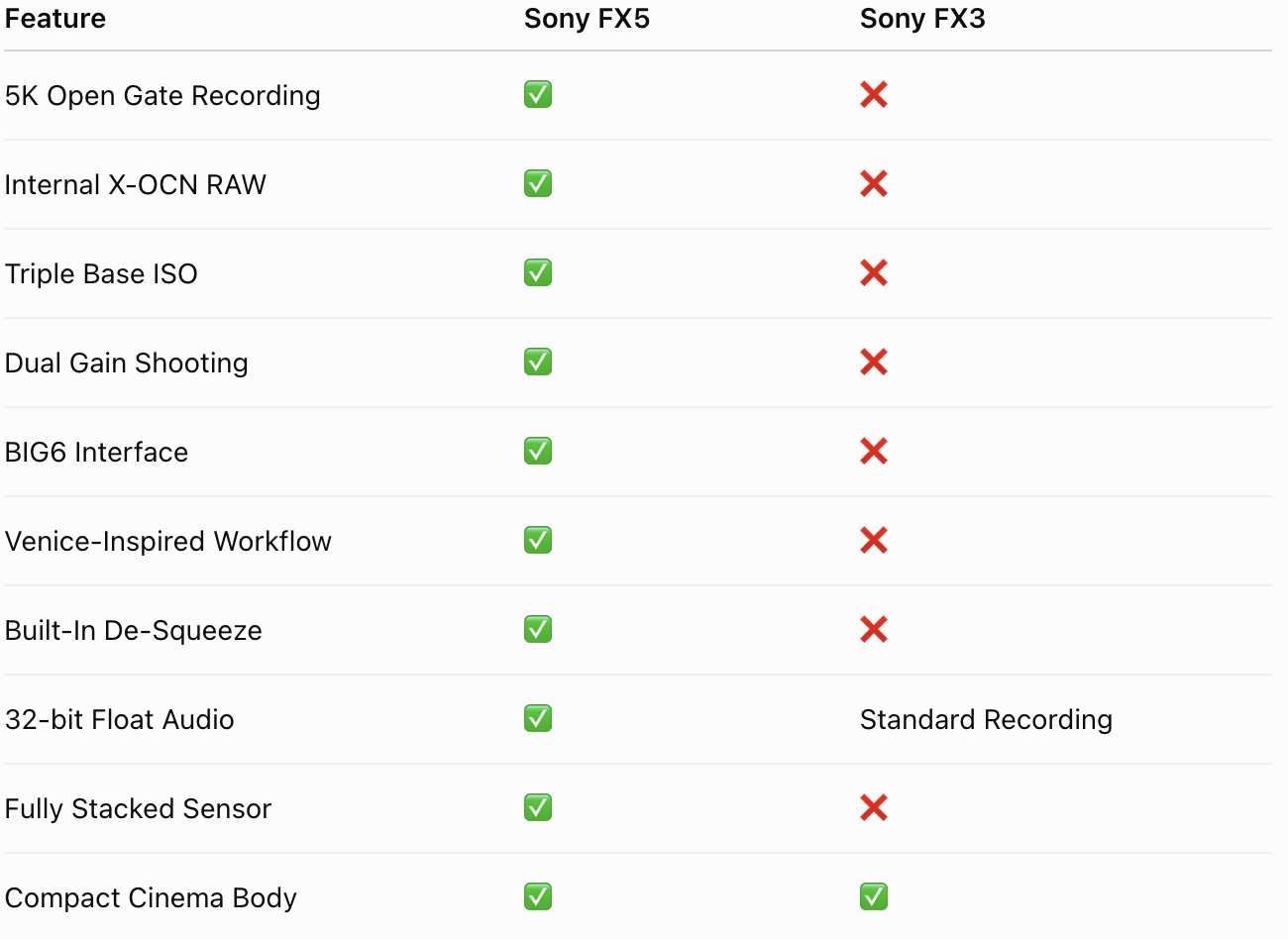
The FX5 introduces things that professional filmmakers have been asking for over the last several years. Open Gate recording allows filmmakers to capture the entire sensor for greater flexibility in post-production. Internal X-OCN RAW recording simplifies high-end workflows without requiring an external recorder. Triple Base ISO, Dual Gain Shooting, Venice-inspired controls, the BIG6 interface, and expanded cinema-focused features all move the FX5 further into professional filmmaking territory.
None of these features dramatically change the quality of the images on their own.
What they change is the experience of using the camera.
Sony appears to have focused less on simply improving image quality and more on improving the entire production workflow, from the moment you begin shooting through final delivery.
That's a very different philosophy than simply releasing a camera with a few upgraded specifications.
Open Gate Alone Might Be Worth The Upgrade For Some People
Of everything Sony announced, Open Gate recording is probably the feature that excites people the most.
Because Open Gate records the entire sensor rather than committing to a traditional widescreen crop, editors have much more flexibility to create different aspect ratios after the shoot. That means cleaner vertical crops, more room to recompose interviews, and significantly greater freedom during editing.
Having spent years shooting with the FX3, we know this is one of those improvements that won't necessarily change how audiences experience the final video, so really for us it’s not that big of a deal.
The Workflow Improvements Add Up
While Open Gate is the headline feature, it's really the combination of improvements that makes the FX5 feel like such a significant step forward.
Internal X-OCN RAW recording simplifies professional color workflows without adding external recorders. The BIG6 interface and updated Cinema Line menus promise a faster, more intuitive shooting experience. Triple Base ISO expands flexibility in changing lighting conditions, while Sony's updated AI processing adds another layer of shooting support.
Individually, none of these features would necessarily convince us to upgrade.
Together, however, they paint a picture of a camera that has been designed specifically for modern professional productions.
Sony isn't simply offering more resolution or more frame rates.
They're refining the workflow from beginning to end.
The FX3 Is Still The Better Choice For A Lot Filmmakers
As much as people are excited about the FX5, we don't think it's automatically the right choice for everyone.
If your budget is limited, the FX3 remains an outstanding investment. In many cases, we'd rather see someone purchase an FX3 and invest the remaining budget into better lenses, lighting, audio equipment, or education than stretch beyond what they're comfortable spending on a camera body.
The FX3 continues to produce beautiful images, remains incredibly compact, and has earned its reputation as one of the best hybrid cinema cameras ever made.
If you already own one, we don't think there's any reason to panic or feel like your camera has suddenly become outdated.
It hasn't.
It's still capable of producing exceptional work.
Which Camera Would We Buy Today?
This is really the reason most people end up reading comparison articles.
And honestly, our answer is pretty simple.
We don't regret buying our FX3 for a second.
It's been an incredible camera, and we'll continue using ours for years to come.
If we were starting from scratch today and deciding between purchasing an FX3 or an FX5, we'd buy the FX3.
We've built countless successful productions around it and we will continue to.
Sony FX5 vs Sony FX3 Comparison
Final Thoughts From BHM
Camera comparisons often turn into debates about which model is "better," but we don't really think that's the right question.
I think the Sony FX5 is going to make a lot of people really happy.
If Open Gate recording, internal X-OCN RAW, and Sony's updated Cinema Line workflow solve problems you've been running into, then I completely understand why this camera is exciting. For some filmmakers, it's probably going to be exactly what they've been waiting for.
For us, though, it's a different story.
We've built our business around interview-driven brand videos, customer testimonials, documentaries, and corporate storytelling. After hundreds of productions with our FX3 and FX6, I honestly don't look at the FX5 and think, "We need that camera."
Could we make great work with it? Absolutely.
Do I think it's a better value than the FX3 for the way we shoot? Not really.
And once you're getting into FX5 pricing, I personally start looking at the FX6 instead. Sony's electronic variable ND filter has become such an important part of our workflow that it's hard for me to justify giving it up for features like Open Gate or internal RAW.
That's what makes cameras fun - there isn't one right answer.
This is simply ours.
If you already own an FX3, keep making great work with it. It's still one of the best compact cinema cameras ever made. If you already own an FX6 and an FX3 like we do, I don't think there's any reason to rush out and buy an FX5.
We'll happily keep filming with our current kit... and spend the money we saved on plane tickets, good lenses, and telling better stories.