Sony FX5 vs Sony FX6: Which Cinema Camera Is Right For You?
TLDR: When Sony announced the FX5, I immediately started comparing it to the cameras we actually use every week - the FX6 and the FX3.
After reading through everything Sony announced, my reaction wasn't "I need one." It was more like..."Huh...that's neat."
Don't get me wrong, the FX5 is packed with some impressive features. I completely understand why some filmmakers are excited about it. I just don't think it's a camera that's solving problems we actually have. The FX5 solves a lot of problems that we simply don't have, so while I think it'll be a fantastic camera for some people, it doesn't really fit into our workflow.
Here’s a great example of the kind of content you can produce with an FX6 set up.
Full Article:
At Bunker Hill Media, our production kit revolves around two Sony FX6s and a Sony FX3. Those cameras have traveled all over the country with us, filming everything from healthcare campaigns and nonprofit documentaries to customer testimonials and brand films. We've spent hundreds of days behind them, and they've become second nature.
So when Sony announced the FX5 with features like Open Gate recording, internal X-OCN RAW, Triple Base ISO, and a redesigned Cinema Line workflow, my first thought wasn't, "We have to buy one."
It was more like...
"Huh... that's interesting."
Don't get me wrong, I think the FX5 is going to be a fantastic camera for the right filmmaker. But after reading through everything Sony announced, I also came away feeling like it solves a lot of problems that we simply don't have.
The Sony FX6 Is An Incredible Cinema Camera
Whenever a new camera is announced, it's easy to forget just how good the previous generation still is.
The Sony FX6 is a perfect example of that.
The internal ND filters are a feature I will never ever be able to work without again. This is a deal breaker for me and the kind of work we do.
Even several years after its release, it's still one of the best cinema cameras we've ever used. The image quality continues to be outstanding. Autofocus remains remarkably reliable. Low-light performance is excellent. The ergonomics are fantastic for long shoot days. It integrates beautifully into professional productions, and perhaps most importantly, it's a camera we simply don't have to think about anymore.
That's actually one of the highest compliments we can give a piece of equipment.
When you're interviewing someone about a deeply personal experience, the last thing you want is to be thinking about camera settings. You want to be listening. You want to be asking better follow-up questions. You want to be paying attention to body language instead of menus.
The FX6 allows us to do that because it has become second nature.
Over the years, we've built our entire workflow around these cameras. We've learned exactly how they behave in difficult lighting situations, how they respond during long interview days, and how to get the most out of them during editing. That kind of familiarity is incredibly valuable, especially when you're working with clients who expect every shoot to go smoothly.
New cameras are exciting, but reliability is hard to replace.
The FX5 Is Going To Be Perfect For Some Filmmakers
I don't think the FX5 is a bad camera.
If your business revolves around creating content for Instagram Reels, TikTok, YouTube Shorts, and every client wants horizontal, vertical, and square deliverables from the same shoot, Open Gate recording is a genuinely useful feature.
If you're constantly recording RAW and have a post-production pipeline built around it, internal X-OCN RAW is another great addition.
Sony clearly listened to filmmakers asking for these features, and I think there are plenty of production companies that are going to get a ton of value out of them.
We're just...not one of them.
The FX5 Feels Like It Was Built For A Different Kind Of Filmmaker
One thing I want to make clear before I get into this article is that I don't think Sony missed the mark with the FX5.
I think they built exactly the camera they intended to build.
The problem—if you can even call it that—is simply that I don't think we're the target audience.
Our company produces documentary-style brand films, customer testimonials, nonprofit stories, executive interviews, and healthcare campaigns. Almost everything we create starts with an interview and ends with a polished horizontal video that lives on a company's website, YouTube channel, LinkedIn page, or conference screen. Every now and then we'll create vertical cutdowns for social media, but those are almost always secondary deliverables rather than the main objective.
Because of that, a lot of the headline features Sony announced simply don't move the needle for us.
That's not because they aren't useful.
It's because they don't really fit into the way we shoot.
Open Gate Is Cool...But We've Never Really Needed It
Open Gate recording is probably the feature that's generating the most conversation right now, and I completely understand why.
Being able to capture the entire sensor and decide later whether your footage should become horizontal, vertical, square, or somewhere in between is undeniably useful. If you're constantly producing content for Instagram Reels, TikTok, YouTube Shorts, paid social campaigns, and every imaginable aspect ratio, Open Gate gives editors a tremendous amount of flexibility.
But I also think it's okay to admit that not every production company works that way.
For us, Open Gate falls into the category of "nice to have."
We've filmed hundreds of interviews without it. We've delivered national campaigns without it. We've never wrapped a shoot and thought, "Man... if only we'd had Open Gate."
Would we use it occasionally?
Probably.
Would it fundamentally change the way we work?
Honestly, I don't think so.
Internal RAW Sounds Great Until You Actually Pay For It
This is probably where my opinion starts to differ from a lot of people online.
Everyone loves seeing the word RAW on a specification sheet. It immediately sounds more professional, more cinematic, and more capable.
And to be fair, there are absolutely productions where RAW recording makes perfect sense.
But for our work, I keep asking myself the same question.
How often would we actually use it?
RAW footage is expensive. CFexpress Type A cards are expensive. Storage is expensive. Backing everything up twice is expensive. Suddenly, a feature that sounds incredible on launch day becomes something that adds a surprising amount of cost to every single production.
For companies producing high-end commercial work every day, that investment probably makes complete sense.
For us, filming interviews and brand stories week after week, I'd honestly rather put that money into better lighting, another lens, travel, or almost anything else that directly impacts the stories we're telling.
Again, that's not a criticism of RAW.
It's just an honest reflection of the kind of work we do.
The FX6 Has One Huge Advantage: Electronic Variable ND
As excited as we are about Open Gate, there's one feature that keeps us firmly in the FX6 camp.
The electronic variable ND filter.
Honestly, it's difficult to explain how valuable this feature is until you've spent months using it on real productions.
On paper, it doesn't sound particularly exciting. It's an ND filter.
In practice, it's one of the biggest workflow improvements we've ever experienced.
When we're filming interviews, documentaries, or brand videos, lighting conditions are constantly changing. Clouds move. Someone opens a door. We step outside between interviews. We move from a conference room into a manufacturing facility. Every location presents different exposure challenges.
With traditional ND filters, that often means stopping production, swapping filters, adjusting ISO, changing shutter speed, or compromising on aperture.
The FX6 eliminates almost all of that.
Instead, we simply roll the electronic ND wheel until exposure is exactly where we want it.
Our aperture stays exactly where we want it for depth of field.
Our shutter speed never changes.
Our ISO remains consistent.
The image stays exactly the way we intended.
It sounds like a small thing.
It isn't.
It allows us to move faster, stay focused on the people we're filming, and spend dramatically less time adjusting the camera between setups.
After hundreds of interviews, it's become one of those features we never want to give up.
Which Camera Fits Different Productions?
The interesting thing is that these two cameras actually feel like they're solving different problems.
If your work revolves around delivering content in multiple aspect ratios, taking advantage of Open Gate workflows, recording internal RAW, and maximizing flexibility during post-production, the FX5 becomes incredibly compelling.
If, however, your work looks more like ours - long interview days, documentaries, nonprofit storytelling, customer testimonials, executive interviews, and corporate productions - the FX6 still offers one of the most enjoyable shooting experiences we've ever had.
Neither approach is wrong.
They're simply different.
Sony now offers two outstanding cinema cameras that prioritize different workflows.
And honestly, after spending years shooting on the FX6 and reading everything Sony has officially announced about the FX5, our answer is pretty simple.
We'd still buy the FX6.
That doesn't mean we think the FX5 is a bad camera. Far from it. We think it's going to be an incredible camera for filmmakers who will genuinely take advantage of features like Open Gate recording, internal X-OCN RAW, and Sony's updated Cinema Line workflow. If those features solve real problems in your day-to-day productions, then the FX5 could absolutely be the right camera for you.
But for us, they simply don't.
What does change the way we work every single day is the FX6's electronic variable ND filter. After filming hundreds of interviews, it's become one of those features we don't even think about anymore—we just rely on it. It allows us to move between locations faster, adapt instantly to changing light, and spend more time paying attention to the person sitting in front of the camera instead of fiddling with exposure settings.
For the kind of documentary-style, interview-driven work we produce every week, that workflow advantage is worth more than Open Gate, internal RAW, or any of the other headline features Sony introduced with the FX5.
So if someone handed us the budget to buy another camera tomorrow?
We'd still buy another FX6.
And honestly, we wouldn't think twice about it.
Sony FX5 vs Sony FX6 Comparison
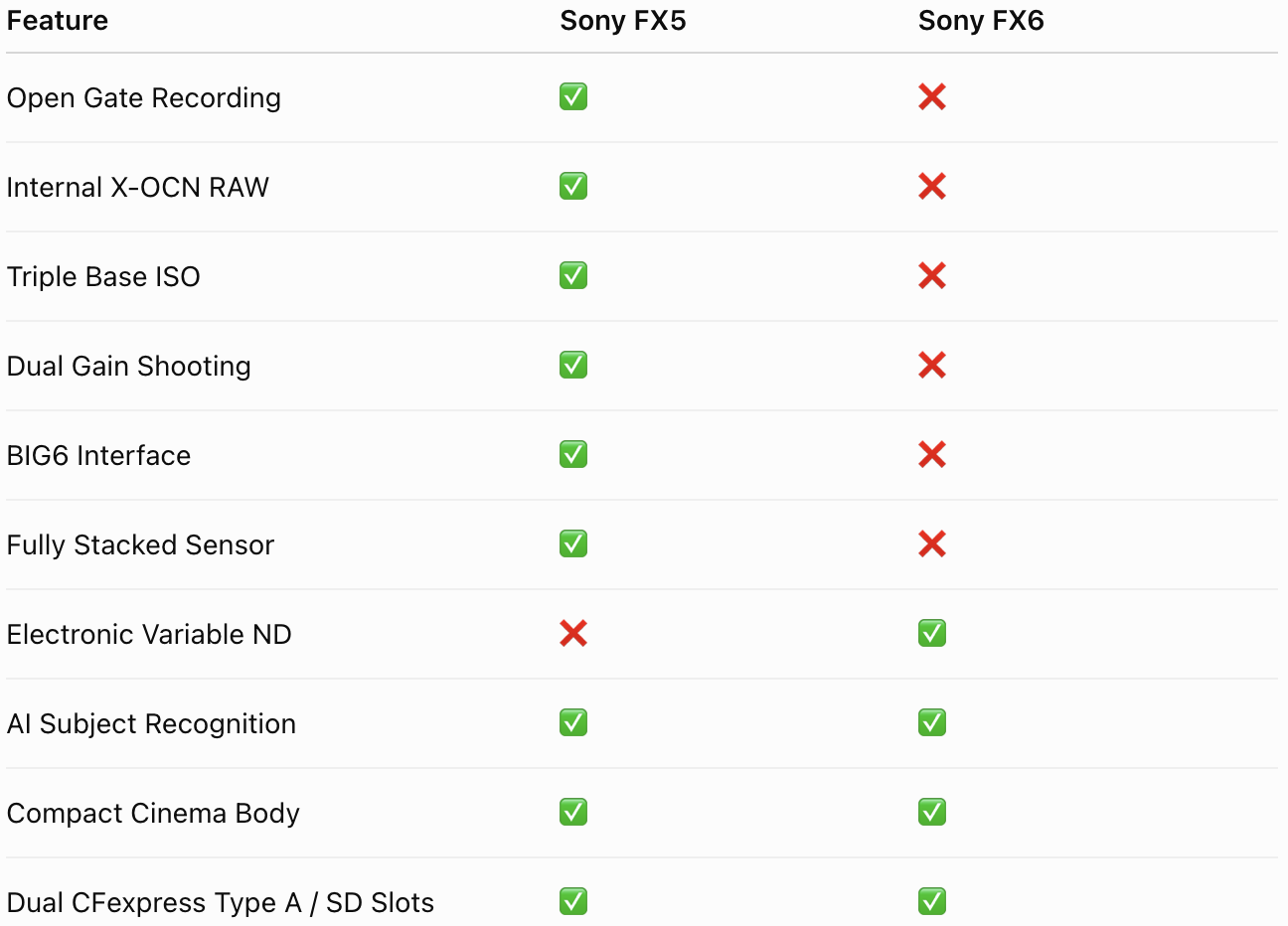
Final Thoughts From Bunker Hill Media
The Sony FX5 is one of the most exciting cinema cameras Sony has released in years. Features like Open Gate recording, internal X-OCN RAW, Triple Base ISO, and a Venice-inspired workflow show that Sony is thinking carefully about the future of professional filmmaking.
But perhaps the most impressive thing about the FX5 is that it doesn't make the FX6 obsolete.
Instead, it gives filmmakers another excellent option.
For production companies focused on modern multi-platform delivery and flexible post-production workflows, the FX5 is going to be incredibly appealing.
For us, though, the FX6 continues to check every box that matters most. After hundreds of interviews and countless production days, we still believe its electronic variable ND filter is one of the smartest features Sony has ever built into a cinema camera. It allows us to work faster, stay focused on our subjects, and spend more time telling stories instead of managing exposure.
Will we eventually add an FX5 to our kit?
Quite possibly.
But if we had to walk onto a client shoot tomorrow and choose one camera for a full day of interview-driven filmmaking, we'd still reach for the Sony FX6.
And honestly, we think that's one of the best compliments we can give it.